Publishers block Anthropic's search crawler far more than OpenAI's
OAI-SearchBot and Claude-SearchBot
do the same job: they fetch pages so an assistant can cite them in an answer. Neither trains a
model. Among the sites that block AI crawlers by name, OpenAI's is allowed through by 85% and
Anthropic's by 31%.
OAI-SearchBot11 of 13 sites
Claude-SearchBot4 of 13 sites
That last number is the finding. Six sites made a considered decision about OpenAI: stay out of the training set, stay in the answers. Exactly one site made the same decision about Anthropic. This does not look like a judgement about Anthropic. It looks like an information gap: publishers have learned that OpenAI runs two crawlers with different jobs, and have not learned it about Anthropic.
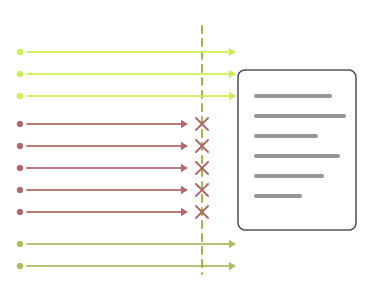
The 14 sites we threw away, and why that matters
This is the part most crawler studies skip, and it is where the number comes from.
Of 131 domains, 27 refused at least one crawler while serving a plain control
request. The obvious move is to report 27. But 14 of those 27 also refused our
Googlebot, and nobody blocks Google. What those sites are actually doing is
checking crawler identity: Cloudflare's verified-bot handling and its equivalents confirm
the request came from the operator's network, and refuse anything merely claiming a crawler's name
from an address that is not theirs.
Our request is exactly that, so it is refused, and the real crawler is waved through. Those 14 sites cannot tell us anything about AI blocking and are excluded. The headline figures use the remaining 13 sites that refuse AI crawlers while serving the search crawlers, which is the only combination that demonstrates a rule keyed on the name.
What got refused, in the 13 sites that key on the name
| Crawler | Purpose | Refused | Sites | % |
|---|---|---|---|---|
| ClaudeBot | training | 9 | 69% | |
| Claude-SearchBot | search | 9 | 69% | |
| GPTBot | training | 8 | 62% | |
| PerplexityBot | search | 8 | 62% | |
| OAI-SearchBot | search | 2 | 15% |
Read the last two rows together. Both are search crawlers. Both exist so an assistant can cite a page. One is refused by 15% of this set and the other by 69%.
The 13 sites, named
| Domain | Refuses |
|---|---|
| nytimes.com | GPTBot, OAI-SearchBot, ClaudeBot, Claude-SearchBot, PerplexityBot |
| profound.so | GPTBot, OAI-SearchBot, ClaudeBot, Claude-SearchBot, PerplexityBot |
| theguardian.com | ClaudeBot, Claude-SearchBot, PerplexityBot |
| apnews.com | ClaudeBot, Claude-SearchBot, PerplexityBot |
| newyorker.com | ClaudeBot, Claude-SearchBot, PerplexityBot |
| vox.com | ClaudeBot, Claude-SearchBot, PerplexityBot |
| theverge.com | ClaudeBot, Claude-SearchBot, PerplexityBot |
| forbes.com | GPTBot, ClaudeBot, Claude-SearchBot |
| linear.app | GPTBot, Claude-SearchBot, PerplexityBot |
| patreon.com | GPTBot, ClaudeBot |
| time.com | GPTBot |
| spiegel.de | GPTBot |
| arstechnica.com | GPTBot |
Note time.com, spiegel.de and arstechnica.com:
GPTBot refused, every search crawler allowed. That is the AEO-literate configuration,
and it is what the other ten could have.
What an AEO practitioner should take from this
Audit your client's robots.txt against their edge, not instead of it. None of the refusals above appear in robots.txt. A checker that reads that file will report all thirteen of these sites as fully open.
Separate training from search when you advise. A publisher who
says "block the AI crawlers" usually means "do not train on me." That is achievable while staying
citable, and on current evidence most sites doing it for OpenAI have not done it for Anthropic. If
your client wants to be in Claude's answers, Claude-SearchBot is a separate decision
from ClaudeBot and probably needs raising explicitly.
Check whether the block was a decision at all. Several of these are CDN defaults nobody chose. The question to ask a client is not "should we allow AI crawlers" but "did you know you are refusing these, and did you mean to?"
Do not trust your own spoofed fetch. Ours is an indication, not evidence, and we say so. A firewall keying on address or forward-confirmed reverse DNS can refuse you and admit the real crawler, or the reverse. Server logs settle it.
Method, and what it cannot tell you
One request per crawler user agent, plus a control request that identifies itself honestly as ours, all issued in the same call so every site meets the same network conditions in the same moment. 131 domains, chosen to be nameable and spread across publishers, SaaS, developer tools, ecommerce and agencies. The list ships with the data: a study over a sample nobody can see is an anecdote.
| Bucket | Sites | Meaning |
|---|---|---|
| served everything | 84 | no refusals at all |
| keys on the name | 27 | refused a crawler while serving the control |
| of which usable | 13 | also served Googlebot, so the rule is about AI |
| of which excluded | 14 | also refused Googlebot: verified-bot enforcement, unmeasurable from outside |
| inconclusive | 16 | the control was refused too, so the site turns away anything that is not a browser |
| unreachable | 4 | could not be audited at all |
The 16 inconclusive sites are named in the data and include Reuters, the FT, the Economist and Bloomberg. We cannot say whether they single out AI crawlers, and we do not. Reporting the sites we could not conclude about is what should make the thirteen believable.
Reproduce it
The data, the domain list and the code are all published. Disagreeing with this should cost you about four minutes.
npx openaeo-audit nytimes.com          # one site, in your terminal
git clone https://github.com/charlacsina/openaeo-audit
node tools/crawler-study.js tools/study/web-500.txt
Raw dataset (JSON) · the rubric as a specification · the same method on one site, explained